

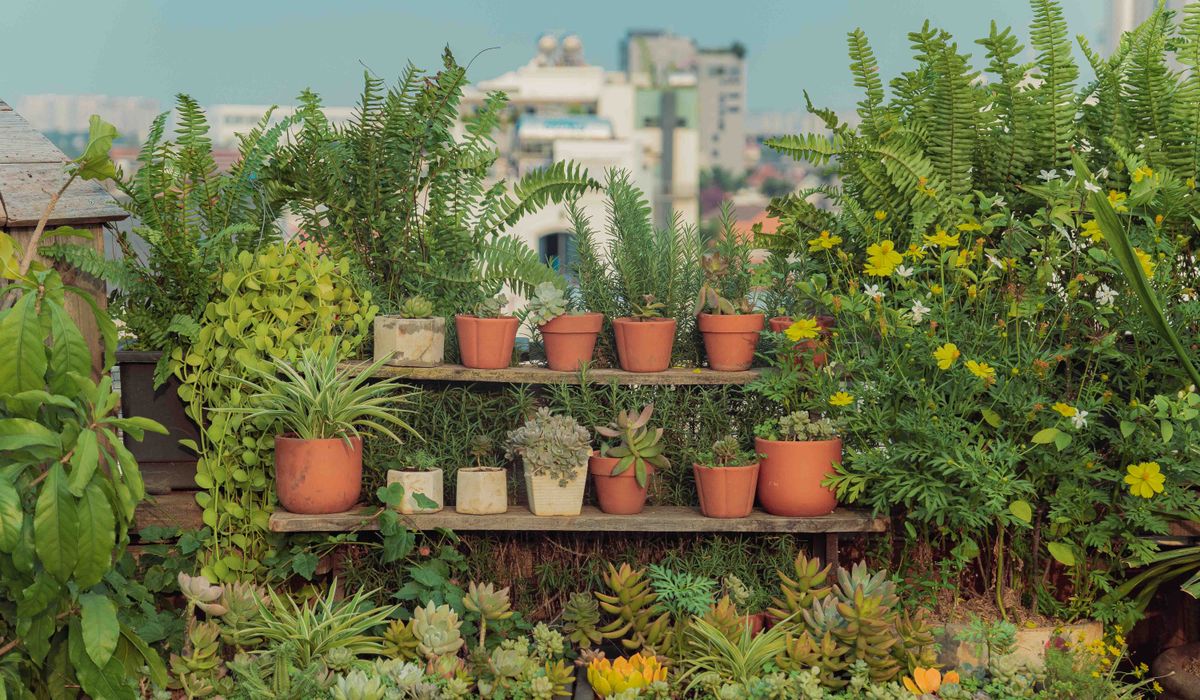
Most small patios fail in January, not July. The summer bedding is spectacular, then everything gets cleared away and you are left with bare compost and a few sad-looking pots. The fix is to design backwards: choose your evergreen bones first, then slot colour in around them.
Aim for three or four permanent shrubs, repeated rather than dotted about. Repetition is what makes a small space feel intentional. Good candidates that cope with UK winters and stay compact include Skimmia japonica 'Rubella', which holds tight red buds all winter before opening in spring; Sarcococca confusa, whose almost invisible flowers scent the whole patio in February; Pittosporum tenuifolium 'Tom Thumb' for dark purple foliage; and Ilex crenata if you want a box-like shape without the risk of blight.
Underneath them, add low planting to hide bare compost. Ajuga reptans, Hakonechloa macra and smaller ferns such as Polystichum all tolerate shade and slug damage better than most. If you only have room for one structural plant, choose a grass that holds its shape through winter — Carex oshimensis 'Evergold' or Stipa tenuissima — and repeat it in three pots at different heights.
Small patios work best when split into two zones: somewhere to sit and somewhere to look at. On a typical 3m x 4m space, that means pushing seating to one edge and keeping a clear walkway of at least 60cm — 90cm if you want to carry a tray through comfortably.
Corners are your friend. A triangular or L-shaped bench in a corner seats three people using less floor space than two chairs. If you need flexibility, a folding bistro set costs nothing in space when not in use, and you can store it flat against the wall. A bench with a lift-up lid also solves the cushion-storage problem that ruins most small patios in October.
Use the walls. A trellis or slatted screen around 1.8m tall gives you vertical growing space without eating floor. Trailing plants in wall-mounted pots, a shelf of small pots at eye level, and a row of hooks for lanterns turn a flat boundary into a third dimension. Just keep the top of the trellis visually light — small-leaved climbers such as jasmine or a compact clematis won't make the space feel closed in.
Think of your pots as a rotating cast. Keep the large containers permanent and change only the smaller ones sitting in front of them.
Match pot size to plant. A shrub in a pot that is too large sits in wet compost and sulks; too small and it dries out every day in July. As a rule, go up one pot size every two years and refresh the top 5cm of compost each spring. Group pots together for mutual shelter and easier watering, and raise them on pot feet so winter rain drains away.
Choose furniture you can leave out, not furniture you have to rescue. Teak, acacia, powder-coated aluminium and rattan-effect pieces all survive a British winter with minimal attention; cheap softwood does not. If you can only buy one thing, buy a decent bench rather than four flimsy chairs.
Consider warmth as part of the design. A sheltered corner facing south or west will be usable on bright days from February onwards. A fire bowl or chiminea extends the season by weeks, and a throw stored in a waterproof box means you actually use the patio in October. Add a small side table for a mug — it sounds trivial, but patios without one never get properly used.
In winter, most of us are out on the patio in the dark, so lighting matters more than planting. Warm-white solar stake lights along the edge, a string of festoon lights across a wall, and two or three lanterns at different heights give real depth. Avoid cool-white light; it makes foliage look grey and flat.
A mirror or a pale-painted wall bounces light and makes a narrow patio feel considerably wider. A shallow water bowl at ground level attracts birds, and scent from sarcococca, winter honeysuckle or a potted daphne carries surprisingly well in cold air.
In late autumn, move tender pots against the house wall, wrap them in bubble wrap or hessian, and raise them off the ground. Use frost-proof terracotta or glazed pots outdoors — cheaper terracotta cracks in a hard frost. Cut back perennials but leave seed heads on grasses and sedum, both for structure and for the birds.
Come February, cut back the grasses, top-dress the pots, plant bulbs for the year ahead, and give the furniture a scrub. That rhythm — structure, rotate, sit, repeat — is what keeps a small patio looking good for twelve months rather than six weeks. Get the bones right once, and the seasonal changes become a pleasure instead of a chore.

The Garden Ledge An honest, everyday look at the things that make life a little better — with advice you can actually use.

The Garden Ledge An honest, everyday look at the things that make life a little better — with advice you can actually use.

Many supermarket herbs can be rooted in water or compost, giving you a cheap and satisfying supply of fresh flavour.

Comments
ALina Kelian
19th May 2018 ReplyThe Garden Ledge No rushing, no fuss — just thoughtful notes and practical help, written by people who care. ullamco laboris nisi ut aliquip ex ea commodo consequat.
Rlex Kelian
19th May 2018 ReplyThe Garden Ledge Written for people who value the details, and want honest guidance they can trust. ullamco laboris nisi ut aliquip commodo.
Roboto Alex
21th May 2018 ReplyThe Garden Ledge Real stories, useful guides and the occasional recommendation, all in one calm corner of the web. ullamco laboris nisi ut aliquip ex ea commodo consequat.